
Re: [MW:33336] Re: 33319] CS material, E70S2- Welder qualified , can he weld SS 316 material & Duplex, Super duplex material with E70s2 qualification ? or he should be qualified by separate SS 316 & Duplex ,SDSS material ?

Dear Mr. Mahesh

Yes you are correct, if the welder is Qualified in P1(CS) he is qualified to weld all metals of P‐No. 1 through P‐No. 15F, P‐No. 34, and P‐No. 41 through P‐No. 49. Since SS material falls in P8, the welder can weld SS Base Metal also.

Regards
SHAM SHAHABUDDIN
QC INSPECTOR - WELDING


On Sat, Jul 30, 2022 at 4:59 PM maheshQAQC <chilukamarimahesh@gmail.com> wrote:
Hi Sir,
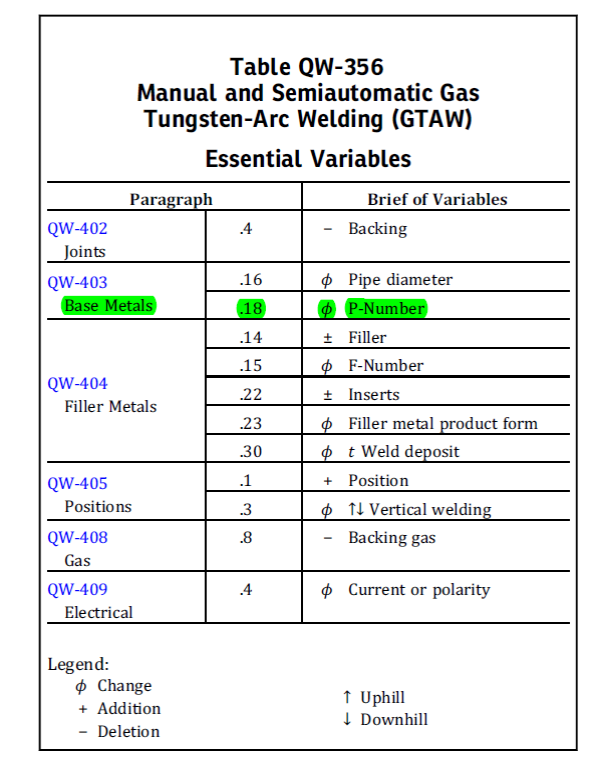
As per QW-423 welder does not required re qualification and he can weld as per table mentioned material. pls correct me if i misinterpret the table. 

thanks
Mahesh


On Friday, 29 July 2022 at 20:55:41 UTC+8 pgos...@rogers.com wrote:

Hi,

The welder is not qualified to weld SS 316 or DSS or SDSS. Though the F No for consumables remain to be the same , the P No gets changed. Hence welder will require new qualification.


Thanks.


Pradip Goswami.P.Eng, IWE.

Independent Welding & Metallurgical Engineering Specialist

Saudi Aramco Approved Designated Project Welding Engineer (DPWR)

Qatar Petroleum Approved, SME-Materials & Corrosion Engineering.

Linkedin: https://www.linkedin.com/in/pradip-goswami-2999855/

Email:pgos...@rogers.com,pradip....@gmail.com

Cell/Whasapp:1-905-9793232


From: material...@googlegroups.com <material...@googlegroups.com> On Behalf Of Madheswaran s
Sent: July 29, 2022 2:12 AM
To: Materials & Welding <material...@googlegroups.com>
Subject: [MW:33319] CS material, E70S2- Welder qualified , can he weld SS 316 material & Duplex, Super duplex material with E70s2 qualification ? or he should be qualified by separate SS 316 & Duplex ,SDSS material ?


Dear Experts,


CS material, E70S2- Welder qualified , can he weld SS 316 material & Duplex, Super duplex material with already  he has E70s2 qualification ? or he should be qualified by separately for SS 316 & Duplex ,SDSS material ?


Thanks,

Madheswarn.S

--
https://materials-welding.blogspot.com/
https://www.linkedin.com/groups/122787
---
You received this message because you are subscribed to the Google Groups "Materials & Welding" group.
To unsubscribe from this group and stop receiving emails from it, send an email to materials-weld...@googlegroups.com.
To view this discussion on the web visit https://groups.google.com/d/msgid/materials-welding/2d44c76c-a78f-402e-80a7-0616f1c9ca0an%40googlegroups.com.


AVG logo

This email has been checked for viruses by AVG antivirus software.
www.avg.com


--
https://materials-welding.blogspot.com/
https://www.linkedin.com/groups/122787
---
You received this message because you are subscribed to the Google Groups "Materials & Welding" group.
To unsubscribe from this group and stop receiving emails from it, send an email to materials-welding+unsubscribe@googlegroups.com.
To view this discussion on the web visit https://groups.google.com/d/msgid/materials-welding/bcd0a5fe-4ecf-4f39-8db4-b10f2e32b756n%40googlegroups.com.

--
https://materials-welding.blogspot.com/
https://www.linkedin.com/groups/122787
---
You received this message because you are subscribed to the Google Groups "Materials & Welding" group.
To unsubscribe from this group and stop receiving emails from it, send an email to materials-welding+unsubscribe@googlegroups.com.
To view this discussion on the web visit https://groups.google.com/d/msgid/materials-welding/CAAyAb6O4c7DPGDs75vFx2xbQHJEoGrhM1f_u%3Dufc6A8s6x%2B3yw%40mail.gmail.com.

Comments

Popular posts from this blog

Heat tint (temper) colours on stainless steel surfaces heated in air // Heat tint

Introduction The colour formed when stainless steel is heated, either in a furnace application or in the heat affected zone of welds, is dependent on several factors that are related to the oxidation resistance of the steel. The heat tint or temper colour formed is caused by the progressive thickening of the surface oxide layer and so, as temperature is increased, the colours change.   Oxidation resistance of stainless steels However, there are several factors that affect the degree of colour change and so there is no a single table of colour and temperature that represents all cases. The colours formed can only be used as an indication of the temperature to which the steel has been heated. Factors affecting the heat tint colours formed Steel composition The chromium content is the most important single factor affecting oxidation resistance. The higher the chromium, the more heat resistant the steel and so the development of the heat tint colou...

Materails FAQs

Q: What are equivalents for standard Q 235 B (and Q 235 A) for U-channels? (asked by: boris.vielhaber@vait.com) A: DIN Nr. = 2393 T.2, 2394 T.2, EN 10025 W. Nr. DIN 17007 = 1.0038 Design DIN 17006 = RSt 37-2, S235JRG2 (Fe 360 B) Q: What is St DIN 2391 BK material? (asked by: dmcandrews@automaticstamp.com) A: Precision steel tubes, cold-finished/hard. Q: What is C.D.W. Boiler Tube? (asked by: montydude123@yahoo.com) A: Cold Drawn Welded Boiler Tube. Q: WHAT IS W.Nr. 1.4301? PLS TELL US IN EASY LANGUAGUE (asked...

The Schaeffler and Delong diagrams for predicting ferrite levels in austenitic stainless steel welds

Introduction Ferrite is important in avoiding hot cracking in during cooling from welding of austenitic stainless steels. 'Constitution diagrams' are used to predict ferrite levels from the composition by comparing the effects of austenite and ferrite stabilising elements. The Schaeffler and Delong diagrams are the original methods of predicting the phase balances in austenitic stainless steel welds. Nickel and chromium equivalents A 'nickel equivalent' is calculated for the austenite stabilising elements and a 'chromium equivalent' ferrite stabilising elements. These are used as the axes for the diagrams, which show the compositional equivalent areas where the phases austenite, ferrite, martensite (and mixtures of these) should be present. Although intended to show the phase balance of weld fillers, these diagrams can also be used to illustrate the phase balance of the 'parent' material. There are different diagrams for dif...