
Re: [MW:33290] WPS THICKNESS QUALIFICATION AD PER SEC IX

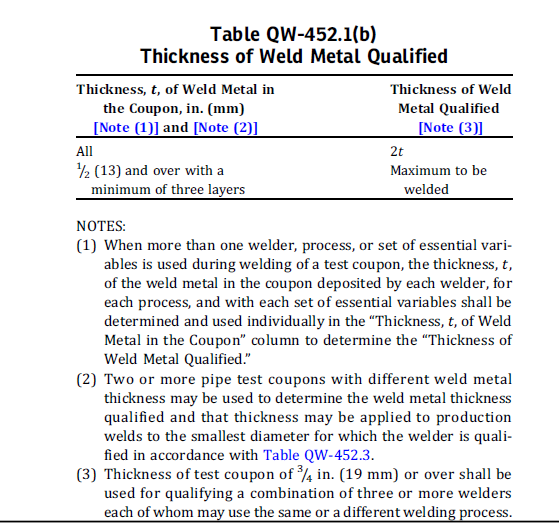
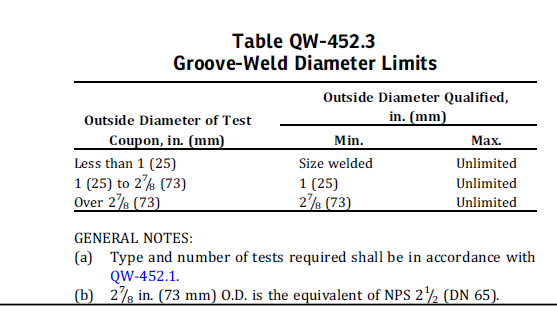
kindly note that  QW-452 -is applicable only for Perfromance qualification , for procedure qualifcation thickness limits one has to follow QW-451 . hope this clarifys.

Thanks 
Srinivas Rao

On Tuesday, July 26, 2022 at 7:30:54 AM UTC+4 srinivas rao wrote:
Dear  Ganesh, 
your undestanding was correct , go ahead.
 kindly ignore mail from Mr. V.Kingsly Geo. BCZ it is applicable for perfromace qualification.

Thanks 
Srinivas Rao
On Monday, July 25, 2022 at 12:14:43 PM UTC+4 kingsly...@gmail.com wrote:
Dear Ganesh,

Job PQR thickness - 25.4mm                                 
Process - GTAW (4mm)+ SMAW(21.4)

as per ASME sec IX, Qualifications range for GTAW 4mm --- min - 5mm, max- that is <19mm, 2t =8mm      ----------------  GTAW - MAX  2t - 8 MM

Qualifications range for SMAW 21.4mm -- min-5mm, max- that is >19mm, 2T=2(25.4)=50.8mm                   ----------------  SMAW - Unlimited Thickness if PQR has been done with 3 layers of welding.

So..
The total thickness welded is 25.4(4+21.4)mm
Total thickness qualified is -=8+50.8=58.8mm                                                                                                ---------------   GTAW - 8 MM MAX  & SMAW  Unlimited thickness

image.png
image.png
Regards,
V.Kingsly Geo.

On Mon, 30 May 2022 at 07:12, Ganesh Muthurajan <qcen...@gmail.com> wrote:
Gent's

Can any one explain with example of thickness qualifications - procedure.

Especially for combination of process with 19mm to 38mm thickness job welded. 
Explain me each and every step. 

Here I explain what I am understand that code. Weather it's wrong please explain.

Example. 

Job PQR thickness - 25.4mm
Process - GTAW (4mm)+ SMAW(21.4)

as per ASME sec IX, Qualifications range for GTAW 4mm --- min - 5mm, max- that is <19mm, 2t =8mm

Qualifications range for SMAW 21.4mm -- min-5mm, max- that is >19mm, 2T=2(25.4)=50.8mm

So..
The total thickness welded is 25.4(4+21.4)mm
Total thickness qualified is -=8+50.8=58.8mm


Is that correct or not.
If it wrong kindly give me a brief lesson to me.

Thank you
Ganesh
QC Welding

--
https://materials-welding.blogspot.com/
https://www.linkedin.com/groups/122787
---
You received this message because you are subscribed to the Google Groups "Materials & Welding" group.
To unsubscribe from this group and stop receiving emails from it, send an email to materials-weld...@googlegroups.com.
To view this discussion on the web visit https://groups.google.com/d/msgid/materials-welding/CAM0EmFJmvaHw6Nv%3DO%3Dm3-0N%2BGS-j0uED9QkRP%3DaXzE3%3DphOGEw%40mail.gmail.com.
--
https://materials-welding.blogspot.com/
https://www.linkedin.com/groups/122787
---
You received this message because you are subscribed to the Google Groups "Materials & Welding" group.
To unsubscribe from this group and stop receiving emails from it, send an email to materials-welding+unsubscribe@googlegroups.com.
To view this discussion on the web visit https://groups.google.com/d/msgid/materials-welding/4d6ca10d-0d7b-4b3a-a5c3-c6884568945an%40googlegroups.com.

Comments

Popular posts from this blog

Re: [MW:34105] SA266 GR4N 4 Cycle SPWHT

Hi,  You are correct, Minimum refers to the one cycle for which this part will expose until final work shop PWHT. hence mill test certificate shall include this.  Max. SPWHT, refers to additional cycles of heat treatment that are reserved for future repairs during equipment lifetime.  Again, these simulated no. Of cycles shall be specified in MTC.  The idea is we need to make sure that steel mechanical properties are not compromised upon exposure to multiple repairs (i e 4 cycles in your case).  One could say, if steel is subjected to 4 cycles and is ok, then it should by defacto be good for one cycle, yet, this is wrong assumption cause mechanical problems and microstructure of materials varies accordingly based on no. Of cycles for which material will expose. This is apparent in alloy steel and especially for impact test values as an example.  In your case, this forged CS with properties before PWHT can be understood to be " as forged" condition (i.e. Wit...

Materails FAQs

Q: What are equivalents for standard Q 235 B (and Q 235 A) for U-channels? (asked by: boris.vielhaber@vait.com) A: DIN Nr. = 2393 T.2, 2394 T.2, EN 10025 W. Nr. DIN 17007 = 1.0038 Design DIN 17006 = RSt 37-2, S235JRG2 (Fe 360 B) Q: What is St DIN 2391 BK material? (asked by: dmcandrews@automaticstamp.com) A: Precision steel tubes, cold-finished/hard. Q: What is C.D.W. Boiler Tube? (asked by: montydude123@yahoo.com) A: Cold Drawn Welded Boiler Tube. Q: WHAT IS W.Nr. 1.4301? PLS TELL US IN EASY LANGUAGUE (asked...

Heat tint (temper) colours on stainless steel surfaces heated in air // Heat tint

Introduction The colour formed when stainless steel is heated, either in a furnace application or in the heat affected zone of welds, is dependent on several factors that are related to the oxidation resistance of the steel. The heat tint or temper colour formed is caused by the progressive thickening of the surface oxide layer and so, as temperature is increased, the colours change.   Oxidation resistance of stainless steels However, there are several factors that affect the degree of colour change and so there is no a single table of colour and temperature that represents all cases. The colours formed can only be used as an indication of the temperature to which the steel has been heated. Factors affecting the heat tint colours formed Steel composition The chromium content is the most important single factor affecting oxidation resistance. The higher the chromium, the more heat resistant the steel and so the development of the heat tint colou...