[MW:30915] Re: Welding of Dissimilar Thickness & Dissimilar P number

Dear Expert need your opinion.

I have WPS/PQR of dissimilar metal GTAW (F11 to SS316L) with Inconel Filler for high temperature application. Inconel filler selected according to API 582 guidelines..but our end user is not accepting Inconel filler because it doesn't have Moly content which is present in base metal.

Any document or write to prove correctness of Inconel filler?

On Tuesday, September 20, 2016 at 11:12:09 AM UTC+5:30, vijay Katkar wrote:
Dear Expert,

Need your guidance,

I have PQR with P1 to P43 with 10 mm thickness,

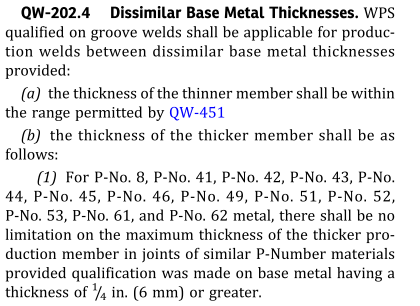
Can i use this PQR for Joint with 10 mm (P1) & 45 mm (P43) under following clause?

Clause no QW 202.4.


Thank you 

Vijay Katkar   

--
https://materials-welding.blogspot.com/
https://www.linkedin.com/groups/122787
---
You received this message because you are subscribed to the Google Groups "Materials & Welding" group.
To unsubscribe from this group and stop receiving emails from it, send an email to materials-welding+unsubscribe@googlegroups.com.
To view this discussion on the web visit https://groups.google.com/d/msgid/materials-welding/1db890c8-5cc2-4bae-b53a-ab54a0ee014e%40googlegroups.com.

Comments

Popular posts from this blog

Materails FAQs

Q: What are equivalents for standard Q 235 B (and Q 235 A) for U-channels? (asked by: boris.vielhaber@vait.com) A: DIN Nr. = 2393 T.2, 2394 T.2, EN 10025 W. Nr. DIN 17007 = 1.0038 Design DIN 17006 = RSt 37-2, S235JRG2 (Fe 360 B) Q: What is St DIN 2391 BK material? (asked by: dmcandrews@automaticstamp.com) A: Precision steel tubes, cold-finished/hard. Q: What is C.D.W. Boiler Tube? (asked by: montydude123@yahoo.com) A: Cold Drawn Welded Boiler Tube. Q: WHAT IS W.Nr. 1.4301? PLS TELL US IN EASY LANGUAGUE (asked...

[MW:36169] Cold Bending Qualification

Dear Experts,  Can anyone share the inspection requirements or a qualification procedure for cold bending? Our client spec states only the requirements for induction bending and would like to know your opinion on the cold bend inspection requirements. The code of construction is B31.3, Max. 5D bends, A106 SS 316L.  Thanks in Advance. -- https://materials-welding.blogspot.com/ https://www.linkedin.com/groups/122787 --- You received this message because you are subscribed to the Google Groups "Materials & Welding" group. To unsubscribe from this group and stop receiving emails from it, send an email to materials-welding+unsubscribe@googlegroups.com . To view this discussion visit https://groups.google.com/d/msgid/materials-welding/1be61cc3-e9c9-4a5f-834d-e8485e248432n%40googlegroups.com .

Heat tint (temper) colours on stainless steel surfaces heated in air // Heat tint

Introduction The colour formed when stainless steel is heated, either in a furnace application or in the heat affected zone of welds, is dependent on several factors that are related to the oxidation resistance of the steel. The heat tint or temper colour formed is caused by the progressive thickening of the surface oxide layer and so, as temperature is increased, the colours change.   Oxidation resistance of stainless steels However, there are several factors that affect the degree of colour change and so there is no a single table of colour and temperature that represents all cases. The colours formed can only be used as an indication of the temperature to which the steel has been heated. Factors affecting the heat tint colours formed Steel composition The chromium content is the most important single factor affecting oxidation resistance. The higher the chromium, the more heat resistant the steel and so the development of the heat tint colou...