
[MW:15821] Re: service wise requirement for PWHT

Dear Friends,
 
How do you think about induction heater for PWHT.
 
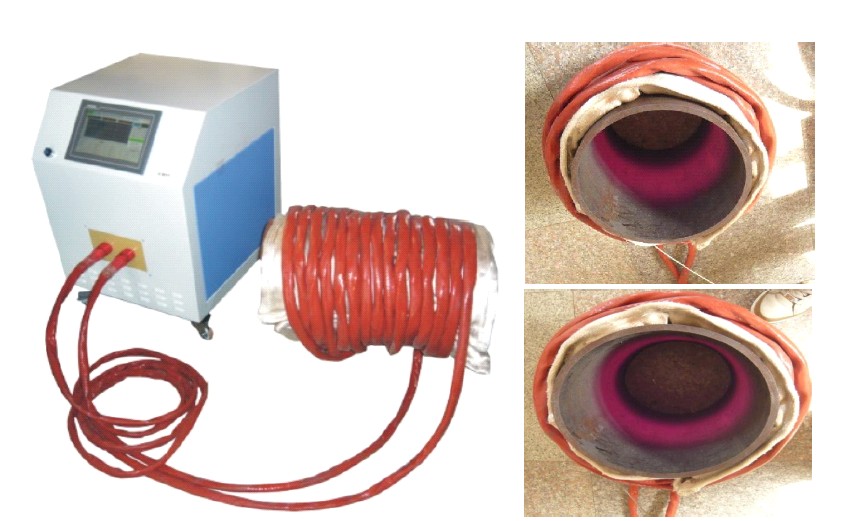
We supply induction heater for PWHT. Pls check the pic.
 
 
1. Around the insulation blanket on the pipe.
2. Around the induction coil on the insulation blanket. (10 ~ 15 turns will be ok)
3. Connect the induction coil on the induction heater.
4. Connect the K type thermocouple on the induction heater. Setting the heating process. The machine will ok.
5. Start the induction heater then It will work well.
 
It has many advantage compare with resistence heater:
  1. Quickly heating speed. It can reach 650 degree C within 30 minutes. It will save many times compare with resistence heater.
  2. Electrical Power Saving: It can save more than 50% electrical power compare with resistence heater.
  3. Stable for long time using: The equipment and induction coil are more stable compare with resistence heater
  4. Easy to operate and move and so on.
  5. The control system is touch PLC screen.


在 2009年7月4日星期六UTC+8下午10时47分39秒,sonu写道:
Hello to all of you.
Dear friends I have one query which I like to ask you
As per table 331.1.1 of ASME B31.3,it is mentioned here the
requirement of PWHT as per thickness and tensile strength for
mentioned materials.But how can I get information according to service
vise? This requirement is depend on project specification but i want
to know that, on which basis they calculate this requirement? Which
factors will consider during calculation? and how this factors affect
during service?
Regards
SADIQUE

--
To post to this group, send email to materials-welding@googlegroups.com
To unsubscribe from this group, send email to materials-welding+unsubscribe@googlegroups.com
For more options, visit this group's bolg at http://materials-welding.blogspot.com/
http://www.linkedin.com/groups/MaterialsWelding-122787?home=&gid=122787&trk=anet_ug_hm
 
The views expressed/exchnaged in this group are members personel views and meant for educational purposes only, Users must take their own decisions w.r.t. applicable code/standard/contract documents.


Comments

Popular posts from this blog

Materails FAQs

Q: What are equivalents for standard Q 235 B (and Q 235 A) for U-channels? (asked by: boris.vielhaber@vait.com) A: DIN Nr. = 2393 T.2, 2394 T.2, EN 10025 W. Nr. DIN 17007 = 1.0038 Design DIN 17006 = RSt 37-2, S235JRG2 (Fe 360 B) Q: What is St DIN 2391 BK material? (asked by: dmcandrews@automaticstamp.com) A: Precision steel tubes, cold-finished/hard. Q: What is C.D.W. Boiler Tube? (asked by: montydude123@yahoo.com) A: Cold Drawn Welded Boiler Tube. Q: WHAT IS W.Nr. 1.4301? PLS TELL US IN EASY LANGUAGUE (asked...

Heat tint (temper) colours on stainless steel surfaces heated in air // Heat tint

Introduction The colour formed when stainless steel is heated, either in a furnace application or in the heat affected zone of welds, is dependent on several factors that are related to the oxidation resistance of the steel. The heat tint or temper colour formed is caused by the progressive thickening of the surface oxide layer and so, as temperature is increased, the colours change.   Oxidation resistance of stainless steels However, there are several factors that affect the degree of colour change and so there is no a single table of colour and temperature that represents all cases. The colours formed can only be used as an indication of the temperature to which the steel has been heated. Factors affecting the heat tint colours formed Steel composition The chromium content is the most important single factor affecting oxidation resistance. The higher the chromium, the more heat resistant the steel and so the development of the heat tint colou...

Re: [MW:10788] ON PLOT PIPING & OFF PLOT PIPING

Piping systems involved for the flow lines and gathering lines from the well head isolation valve to the production facility or processing plant isolation valve are determined as OFF PLOT. ON PLOT defines piping system in the processing plant and production platform. ANSI/ASME B31.4 applies for off plot piping system. B31.4 allows the use of either API 1104 or ASME section IX (as appropriate). However, occasionally, a very small system such as piping within 500 feet of a processing plant (some client also said 400 feet) may be declared B31.3 rather than B31.4. When B31.3 is invoked, only ASME Section IX is used. before you decide which code to use for welding procedure and/or welder qualification for pipe welding, you have to know the design and construction code applicable to the system. Please read far enough into scope and diagram illustrating the application of either B31.3 and B31.4 hope this helps rgds 2011/4/21 pradip kumar sil < pradipsil@gmail.com > Dear all, ...