Regards.
Anil
http://in.linkedin.com/pub/anil-barik/13/aba/1a8/
On Wednesday, April 16, 2014 8:30:40 AM UTC+5:30, pgoswami wrote:
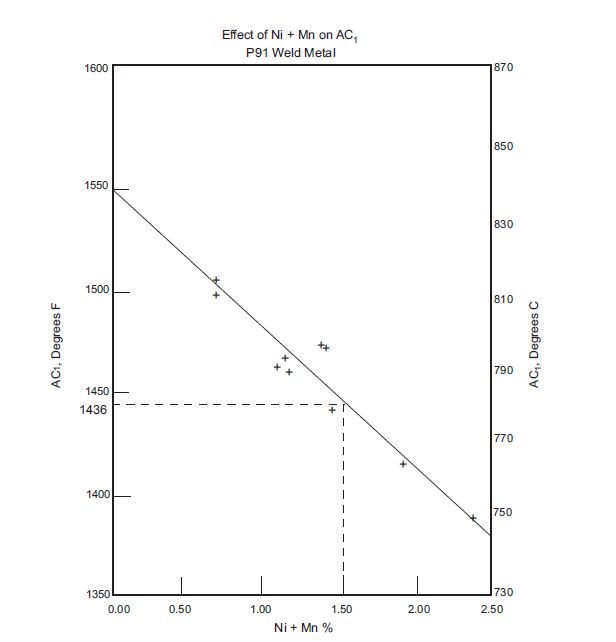
Hi Himan,Ni+Mn in excess of 1.5% (older requirements) affects the AC1 temperature as illustrated below. For all good mechanical properties of P-91 welds this restriction should be maintained. In 2013 version of Sec-1 code max limit of Ni+Mn is restricted to 1.2%(see below). However in Sec-II, Pt-C , SFA 5.5, Table-2, this limit is still 1.5% Max.Procurement of welding consumables should be based on 1.2% max limits , provided 2013 Sec-I code is being followed.Based on this restriction one may choose the best PWHT temperature for Grade-91 welds, which should be below the AC1 temperature. PWHT in excess of AC1 temperature will reformation of Austenite during exposure to intercritical temperature range (above AC1 temperature) which will turn into martensite upon cooling. This defeats the purpose of temperingHope this clears your doubts.Thanks.Pradip Goswami, P.Eng,IWEWelding & Metallurgical SpecialistOntario, Canada(3) For welds made with nickel-based filler metals, or with Grade 91 filler metal (e.g., AWS B9, EN CrMo91, etc.) that has Ni + Mn content less than or equal to 1.0%, the maximum holding temperature can be increased to 1,470°F (800°C). However, if the PWHT encompasses multiple welds and any one of those welds was made with Grade 91 filler metal that has a Ni + Mn content greater than 1.0%, but not greater than 1.2%, or if the Ni + Mn content of the filler metal is unknown, the maximum PWHT temperature shall be 1,445°F (785°C).
Explanatory Note to (3) Above: The lower transformation temperature for matching filler material is affected by alloy content, primarily the total of Ni + Mn. The maximum holding temperature has been set to avoid heat treatment in the intercritical zone.
From: material...@
googlegroups.com [mailto:material...@googlegroups.com ] On Behalf Of Himan Nikdin
Sent: Sunday, April 13, 2014 11:22 PM
To: material...@googlegroups.com
Subject: [MW:20584] Quarry regarding SFA 5.5
Dear Experts
As per note "J" of Table 2 of SFA A5.5 (SPECIFICATION FOR LOW- ALLOY STEEL ELECTRODES FOR SHIELDED METAL ARC WELDING) which contain chemical composition
requirements for weld metal Ni+Mn content shall be max. 1.5% for E9015-B9, E9016-B9, E9018-B9, the question is why?
Regards,
Himan Nikdin
--
To post to this group, send email to material...@googlegroups.com
To unsubscribe from this group, send email to materials-weld...@googlegroups.com
For more options, visit this group's bolg at http://materials-welding.blogspot.com/
http://www.linkedin.com/groups/MaterialsWelding- 122787?home=&gid=122787&trk= anet_ug_hm
The views expressed/exchnaged in this group are members personel views and meant for educational purposes only, Users must take their own decisions w.r.t. applicable code/standard/contract documents.
---
You received this message because you are subscribed to the Google Groups "Materials & Welding" group.
To unsubscribe from this group and stop receiving emails from it, send an email to materials-weld...@googlegroups.com .
For more options, visit https://groups.google.com/d/optout .
____________________________________________________________ __________
The information in this email is confidential, and is intended solely for the addressee(s). If you are not the intended recipient of this email please let us know by reply and then delete it from your system; you should not copy this message or disclose its contents to anyone. The internet can not guarantee the integrity of this message. HAMON (and its subsidiaries) shall (will) not therefore be liable for the message if modified.
____________________________________________________________ __________
--
To post to this group, send email to material...@googlegroups.com
To unsubscribe from this group, send email to materials-weld...@googlegroups.com
For more options, visit this group's bolg at http://materials-welding.blogspot.com/
http://www.linkedin.com/groups/MaterialsWelding- 122787?home=&gid=122787&trk= anet_ug_hm
The views expressed/exchnaged in this group are members personel views and meant for educational purposes only, Users must take their own decisions w.r.t. applicable code/standard/contract documents.
---
You received this message because you are subscribed to the Google Groups "Materials & Welding" group.
To unsubscribe from this group and stop receiving emails from it, send an email to materials-weld...@googlegroups.com .
For more options, visit https://groups.google.com/d/optout .
To post to this group, send email to materials-welding@googlegroups.com
To unsubscribe from this group, send email to materials-welding+unsubscribe@googlegroups.com
For more options, visit this group's bolg at http://materials-welding.blogspot.com/
http://www.linkedin.com/groups/MaterialsWelding-122787?home=&gid=122787&trk=anet_ug_hm
The views expressed/exchnaged in this group are members personel views and meant for educational purposes only, Users must take their own decisions w.r.t. applicable code/standard/contract documents.
---
You received this message because you are subscribed to the Google Groups "Materials & Welding" group.
To unsubscribe from this group and stop receiving emails from it, send an email to materials-welding+unsubscribe@googlegroups.com.
For more options, visit https://groups.google.com/d/optout.
Comments