Re: [MW:30796] Heat input and cooling

High Heat Input reduces the Cooling rate as the Peak temperatures experienced from the weld zone is wider, moreover thermal conductivity remains same and it varies based on critical thicknesss as it changes from 2 Dimensional flow to 3 Dimensional flow as thickness is increased. That is the reason why Preheating  is done for thicker steels to reduce the cooling rate.

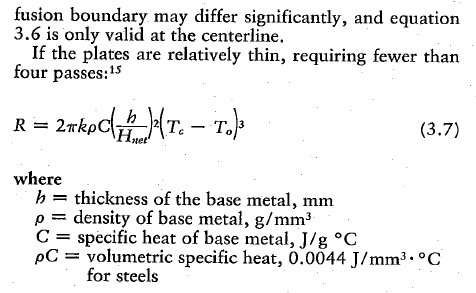
Cooling Rate Formula for 3D Flow.

Inline image
You will also note from the above Formula That Cooling Rate R is inversely proportional to Heat Input Hnet.

Please also find below the Cooling Rate formula for 2 Dimensional Flow.

Inline image


Above formulas from AWS Handbook.

Thanks & Regards

J.Gerald Jayakumar


On Sunday, April 19, 2020, 12:00:54 PM GMT+7, Student <nabeel233@gmail.com> wrote:


Dear all
I am confused about the following statement. Can anyone tell me the reason.

High heat input causes slow cooling and low heat input causes fast cooling.

I understand that cooling is a function of temperature differences between the metal and ambulance system. If high heat input causes high temperature then temperature differential should be higher than low heat input.
Can any one tell me the reason.

--
---
You received this message because you are subscribed to the Google Groups "Materials & Welding" group.
To unsubscribe from this group and stop receiving emails from it, send an email to materials-welding+unsubscribe@googlegroups.com.
To view this discussion on the web visit https://groups.google.com/d/msgid/materials-welding/16692389-12f7-4b45-8ad4-e03a92e6c9b2%40googlegroups.com.

Comments

Popular posts from this blog

Materails FAQs

Q: What are equivalents for standard Q 235 B (and Q 235 A) for U-channels? (asked by: boris.vielhaber@vait.com) A: DIN Nr. = 2393 T.2, 2394 T.2, EN 10025 W. Nr. DIN 17007 = 1.0038 Design DIN 17006 = RSt 37-2, S235JRG2 (Fe 360 B) Q: What is St DIN 2391 BK material? (asked by: dmcandrews@automaticstamp.com) A: Precision steel tubes, cold-finished/hard. Q: What is C.D.W. Boiler Tube? (asked by: montydude123@yahoo.com) A: Cold Drawn Welded Boiler Tube. Q: WHAT IS W.Nr. 1.4301? PLS TELL US IN EASY LANGUAGUE (asked...

Heat tint (temper) colours on stainless steel surfaces heated in air // Heat tint

Introduction The colour formed when stainless steel is heated, either in a furnace application or in the heat affected zone of welds, is dependent on several factors that are related to the oxidation resistance of the steel. The heat tint or temper colour formed is caused by the progressive thickening of the surface oxide layer and so, as temperature is increased, the colours change.   Oxidation resistance of stainless steels However, there are several factors that affect the degree of colour change and so there is no a single table of colour and temperature that represents all cases. The colours formed can only be used as an indication of the temperature to which the steel has been heated. Factors affecting the heat tint colours formed Steel composition The chromium content is the most important single factor affecting oxidation resistance. The higher the chromium, the more heat resistant the steel and so the development of the heat tint colou...

Re: [MW:10788] ON PLOT PIPING & OFF PLOT PIPING

Piping systems involved for the flow lines and gathering lines from the well head isolation valve to the production facility or processing plant isolation valve are determined as OFF PLOT. ON PLOT defines piping system in the processing plant and production platform. ANSI/ASME B31.4 applies for off plot piping system. B31.4 allows the use of either API 1104 or ASME section IX (as appropriate). However, occasionally, a very small system such as piping within 500 feet of a processing plant (some client also said 400 feet) may be declared B31.3 rather than B31.4. When B31.3 is invoked, only ASME Section IX is used. before you decide which code to use for welding procedure and/or welder qualification for pipe welding, you have to know the design and construction code applicable to the system. Please read far enough into scope and diagram illustrating the application of either B31.3 and B31.4 hope this helps rgds 2011/4/21 pradip kumar sil < pradipsil@gmail.com > Dear all, ...