[MW:24023] Re: 15720] PQR - WPS - PWHT P91 to CS


Dear Mr.Pradip Goswami'


                                   Please shared the remaining avrbation of B1,B3,B9 IN TABLE.

On Sunday, October 21, 2012 at 5:22:14 AM UTC+3, pgoswami wrote:
Hi Zakaria,
 
Dissimilar welds between Grade-91 to other lower alloyed steels e.g  grade 11 and grade 22 are quite common. However a straight change from Grade-91 to Carbon steel is a Bad Design, unless the margins provided by the OEM takes care of the service induced damages.
 
A straight service induced damages could be a few as mentioned:-
  • Grade-91 steel operates at very high operating temperature regime (550-560 Deg C), which is is not safe for P1 material. P1 materials in the vicinity of the weld is  likely to get exposed to spheroidization (on exposure to this temperature range) and may result in failures by creep
  • Thus welding of a intermediate or  transition  spool piece such as Grade-22 steel  would be a better design.
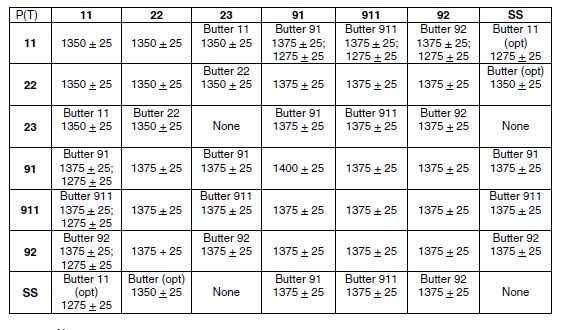
Grade-91 to Grade-22 could be welded in a few ways, see the following tables for welding materials selection and subsequent PWHT.
 
You may qualify a WPS /PQR , however that does not always mean that the good  engineering  design basis is maintained.
 
Also please see below the comments on your queries.
 
Thanks


Pradip Goswami,P.Eng.IWE

Welding & Metallurgical Specialist

Ontario, Canada.

Email-pgoswami@sympatico.ca,

pgoswami@quickclic.net

Dissimilar Welding Filler Metal Selection-


Recommended PWHT Temperatures (

0F) for Dissimilar Welds


From: material...@googlegroups.com [mailto:material...@googlegroups.com] On Behalf Of Zakaria ghrab
Sent: Saturday, October 20, 2012 6:29 AM
To: material...@googlegroups.com
Subject: [MW:15720] PQR - WPS - PWHT P91 to CS

Dear experts,

 Need your support.

We performed one PQR P91 grade ( P number 15E) to Carbon steel (P number 1) welded GTAW/SMAW ER90S-B9 / E9015-B9, 11mm thickness, PWHT @ 740°C - 40 minutes.

PQR and related WPS already approved by our client. but the Owner consulting agency sent to us some comments :

1- No possible to weld P91 directly to CS shall add transition material P11 grade : We answer that it's design issue and i requested some explain / calculation from design. -- This  is a good and conservative design. If accepted one may have to weld the transition pieces, i.e involving welds between P91-P4 & P4-P1 base metal.The PWHT may be controlled to the better extent such that the P1 base metal would not get over tempered.

2- Should use filler metal compatible with lower grade material : i answer that can make choice of  filler metal between to material grades (included) so we can weld with lower, heigher or iontermediate filler metal when mechanical properties is ok and don't have ebjection from project spec. --If you're welding in the above sequence recommendation would be :
  • P91-P4  -welds use -E/ER 8016/18 electrde/ filler metal
  • P4--P1 -welds use -E/ER 8016/18 electrode/ filler metal

3- this is the main issue : PWHT @ 740 °c is heigher than lower critical temperature for CS so we must perform PWHT in intermediate Temperature : in this case if will do like this WPS will not supported by Prepared PQR; --740Deg Cis quite high a temeprature for P1 steel , which could cause over tempeating of this steel 

PQR approved by Client and weld already done, i propose to perform hardness test, PMI and metallographic replic in production ( just one weld) to confirm.


Need your support .


Regards.


--
زكرياء غراب
GHRAB Zakaria

--
To post to this group, send email to material...@googlegroups.com
To unsubscribe from this group, send email to materials-weld...@googlegroups.com
For more options, visit this group's bolg at http://materials-welding.blogspot.com/
http://www.linkedin.com/groups/MaterialsWelding-122787?home=&gid=122787&trk=anet_ug_hm
 
The views expressed/exchnaged in this group are members personel views and meant for educational purposes only, Users must take their own decisions w.r.t. applicable code/standard/contract documents.


--
You received this message because you are subscribed to the Google Groups "Materials & Welding" group.
To unsubscribe from this group and stop receiving emails from it, send an email to materials-welding+unsubscribe@googlegroups.com.
To post to this group, send email to materials-welding@googlegroups.com.
Visit this group at https://groups.google.com/group/materials-welding.
To view this discussion on the web visit https://groups.google.com/d/msgid/materials-welding/e4eb41d5-5740-42a9-bcd1-303d45befad7%40googlegroups.com.
For more options, visit https://groups.google.com/d/optout.

Comments

Popular posts from this blog

Materails FAQs

Q: What are equivalents for standard Q 235 B (and Q 235 A) for U-channels? (asked by: boris.vielhaber@vait.com) A: DIN Nr. = 2393 T.2, 2394 T.2, EN 10025 W. Nr. DIN 17007 = 1.0038 Design DIN 17006 = RSt 37-2, S235JRG2 (Fe 360 B) Q: What is St DIN 2391 BK material? (asked by: dmcandrews@automaticstamp.com) A: Precision steel tubes, cold-finished/hard. Q: What is C.D.W. Boiler Tube? (asked by: montydude123@yahoo.com) A: Cold Drawn Welded Boiler Tube. Q: WHAT IS W.Nr. 1.4301? PLS TELL US IN EASY LANGUAGUE (asked...

Heat tint (temper) colours on stainless steel surfaces heated in air // Heat tint

Introduction The colour formed when stainless steel is heated, either in a furnace application or in the heat affected zone of welds, is dependent on several factors that are related to the oxidation resistance of the steel. The heat tint or temper colour formed is caused by the progressive thickening of the surface oxide layer and so, as temperature is increased, the colours change.   Oxidation resistance of stainless steels However, there are several factors that affect the degree of colour change and so there is no a single table of colour and temperature that represents all cases. The colours formed can only be used as an indication of the temperature to which the steel has been heated. Factors affecting the heat tint colours formed Steel composition The chromium content is the most important single factor affecting oxidation resistance. The higher the chromium, the more heat resistant the steel and so the development of the heat tint colou...

Re: [MW:10788] ON PLOT PIPING & OFF PLOT PIPING

Piping systems involved for the flow lines and gathering lines from the well head isolation valve to the production facility or processing plant isolation valve are determined as OFF PLOT. ON PLOT defines piping system in the processing plant and production platform. ANSI/ASME B31.4 applies for off plot piping system. B31.4 allows the use of either API 1104 or ASME section IX (as appropriate). However, occasionally, a very small system such as piping within 500 feet of a processing plant (some client also said 400 feet) may be declared B31.3 rather than B31.4. When B31.3 is invoked, only ASME Section IX is used. before you decide which code to use for welding procedure and/or welder qualification for pipe welding, you have to know the design and construction code applicable to the system. Please read far enough into scope and diagram illustrating the application of either B31.3 and B31.4 hope this helps rgds 2011/4/21 pradip kumar sil < pradipsil@gmail.com > Dear all, ...