Re: [MW:32096] Impact energy Vs Structure

Dear sir,

Greetings for the day 

Mild steel - BCC structure (body centred cubic ) 
Austenite stainless steel - FCC structure (face centered cubic) 
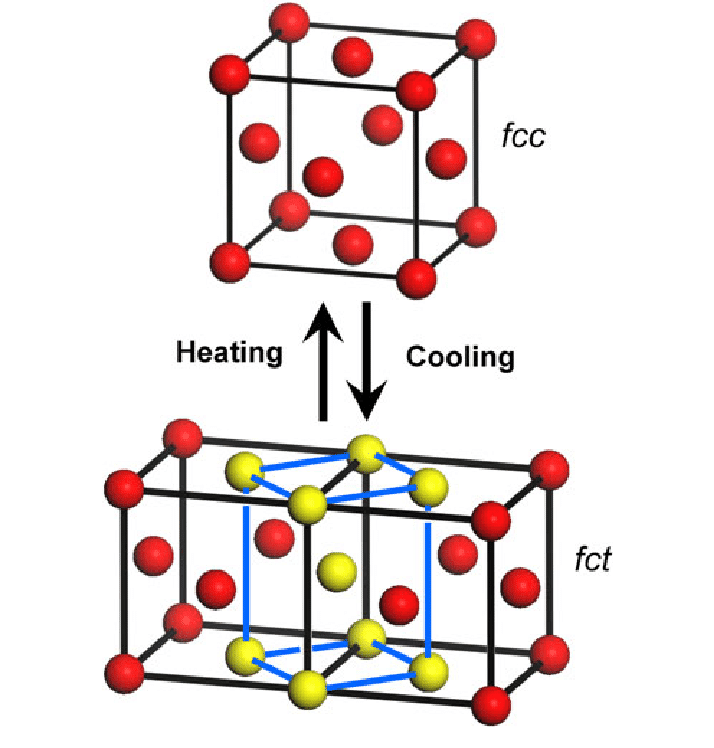
Martensite - FCT structure  ( face centred tetragonal )

coarse grain means - less FCT crystals , fine grain means - More FCT crystals. 

Tetragonal structure can't absorb more impact energy , due to its crystal structure , since it prevents its movement . if it's fine grain , still more difficulty to absorb energy . 

That's why FCC crystals have better impact properties than any other in the steel family .Fine Grain FCC - greater impact energy absorption.


Regards

Vinoth kanna
QC- welding & piping inspector 
Manifa Project

API -510, CSWIP 3.1, NDT level II - UT, RT ,PT, MT, VT,LT,Infrared & Thermography 
Technical - Metallurgy

Contact : M - +91-9787954338,+966-539127946
              Email id : srvkanna1@gmail.com


On Thu, Mar 25, 2021 at 8:43 AM EmaD FaRaHanI <emad.farahani@gmail.com> wrote:
Dear Friends,
Consider we have a mild-steel, cooling fast from welding temperature, we must have a fine grain structure with martensite formation.
Hypothetically, considering that we want to use this structure. I was wondering what is the relation between the impact energy and the structure? will it be decreased due to martensite formation? or increased due to fine grain? I understand that we don't use the martensite state of structures and we need to quench and tempering them.

Thanks,
Emad

--
https://materials-welding.blogspot.com/
https://www.linkedin.com/groups/122787
---
You received this message because you are subscribed to the Google Groups "Materials & Welding" group.
To unsubscribe from this group and stop receiving emails from it, send an email to materials-welding+unsubscribe@googlegroups.com.
To view this discussion on the web visit https://groups.google.com/d/msgid/materials-welding/CABtwbJFboLm6H50x3K8NLgFACWovNv1ETBoBudSrKunaHFm_aw%40mail.gmail.com.

--
https://materials-welding.blogspot.com/
https://www.linkedin.com/groups/122787
---
You received this message because you are subscribed to the Google Groups "Materials & Welding" group.
To unsubscribe from this group and stop receiving emails from it, send an email to materials-welding+unsubscribe@googlegroups.com.
To view this discussion on the web visit https://groups.google.com/d/msgid/materials-welding/CADbO-YZjzSNu3kGJDJAAJYAYHWwX2AbpE0%2BtueJ%2Bkf2y_C9MZw%40mail.gmail.com.

Comments

Popular posts from this blog

Heat tint (temper) colours on stainless steel surfaces heated in air // Heat tint

Introduction The colour formed when stainless steel is heated, either in a furnace application or in the heat affected zone of welds, is dependent on several factors that are related to the oxidation resistance of the steel. The heat tint or temper colour formed is caused by the progressive thickening of the surface oxide layer and so, as temperature is increased, the colours change.   Oxidation resistance of stainless steels However, there are several factors that affect the degree of colour change and so there is no a single table of colour and temperature that represents all cases. The colours formed can only be used as an indication of the temperature to which the steel has been heated. Factors affecting the heat tint colours formed Steel composition The chromium content is the most important single factor affecting oxidation resistance. The higher the chromium, the more heat resistant the steel and so the development of the heat tint colou...

Materails FAQs

Q: What are equivalents for standard Q 235 B (and Q 235 A) for U-channels? (asked by: boris.vielhaber@vait.com) A: DIN Nr. = 2393 T.2, 2394 T.2, EN 10025 W. Nr. DIN 17007 = 1.0038 Design DIN 17006 = RSt 37-2, S235JRG2 (Fe 360 B) Q: What is St DIN 2391 BK material? (asked by: dmcandrews@automaticstamp.com) A: Precision steel tubes, cold-finished/hard. Q: What is C.D.W. Boiler Tube? (asked by: montydude123@yahoo.com) A: Cold Drawn Welded Boiler Tube. Q: WHAT IS W.Nr. 1.4301? PLS TELL US IN EASY LANGUAGUE (asked...

The Schaeffler and Delong diagrams for predicting ferrite levels in austenitic stainless steel welds

Introduction Ferrite is important in avoiding hot cracking in during cooling from welding of austenitic stainless steels. 'Constitution diagrams' are used to predict ferrite levels from the composition by comparing the effects of austenite and ferrite stabilising elements. The Schaeffler and Delong diagrams are the original methods of predicting the phase balances in austenitic stainless steel welds. Nickel and chromium equivalents A 'nickel equivalent' is calculated for the austenite stabilising elements and a 'chromium equivalent' ferrite stabilising elements. These are used as the axes for the diagrams, which show the compositional equivalent areas where the phases austenite, ferrite, martensite (and mixtures of these) should be present. Although intended to show the phase balance of weld fillers, these diagrams can also be used to illustrate the phase balance of the 'parent' material. There are different diagrams for dif...