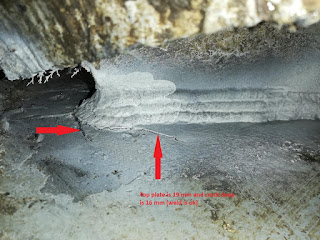
[MW:34836] crack in main plate with thinness 19 mm


Dear All
We have encountered a critical issue with the joints from the beam to the main plate on the Spud Can top plate of our jack-up rig. Upon welding and subsequently lowering the spud can into the water using the jacking system, cracks have emerged in three of the joints that were welded previously ( according to photos cracks happen on the plate) This is a concerning development, and we must address it promptly to ensure the integrity and safety of our spud can.
Considering that in the area where we are, the depth of water is low and there is not much pressure on the spud can, the reason why this happens is not clear to us, and if anyone can advise on this matter, I would be very grateful.

Main top plate thickness is 19 mm and crack depth is 16 mm.

Regards
Babak

Comments

Popular posts from this blog

Heat tint (temper) colours on stainless steel surfaces heated in air // Heat tint

Introduction The colour formed when stainless steel is heated, either in a furnace application or in the heat affected zone of welds, is dependent on several factors that are related to the oxidation resistance of the steel. The heat tint or temper colour formed is caused by the progressive thickening of the surface oxide layer and so, as temperature is increased, the colours change.   Oxidation resistance of stainless steels However, there are several factors that affect the degree of colour change and so there is no a single table of colour and temperature that represents all cases. The colours formed can only be used as an indication of the temperature to which the steel has been heated. Factors affecting the heat tint colours formed Steel composition The chromium content is the most important single factor affecting oxidation resistance. The higher the chromium, the more heat resistant the steel and so the development of the heat tint colou...

[MW:5202] RE: 5200] NDT after PWHT

------------------------------------- Interpretation:  I‑89‑14 Subject:         Section I (1986 Edition, 1987 Addenda), PW‑11,                  NDE Prior to PWHT Date Issued:     December 15, 1988 File:            BC88‑393   Question: Does PW‑11 require that NDE be performed on welds after they have been subjected to the postweld heat treatment required by PW‑39?   Reply: No, unless the conditions described in PW‑11.2.2 exist. ---------------------------------------------- Interpretation:  VIII-1-98-09 Subject:         Section VIII, Division 1 (1995 Edition, 1996 Addenda); NDE                 ...

Materails FAQs

Q: What are equivalents for standard Q 235 B (and Q 235 A) for U-channels? (asked by: boris.vielhaber@vait.com) A: DIN Nr. = 2393 T.2, 2394 T.2, EN 10025 W. Nr. DIN 17007 = 1.0038 Design DIN 17006 = RSt 37-2, S235JRG2 (Fe 360 B) Q: What is St DIN 2391 BK material? (asked by: dmcandrews@automaticstamp.com) A: Precision steel tubes, cold-finished/hard. Q: What is C.D.W. Boiler Tube? (asked by: montydude123@yahoo.com) A: Cold Drawn Welded Boiler Tube. Q: WHAT IS W.Nr. 1.4301? PLS TELL US IN EASY LANGUAGUE (asked...